Smart Air Conditioning Market Size, Share And Trends Report, 2030
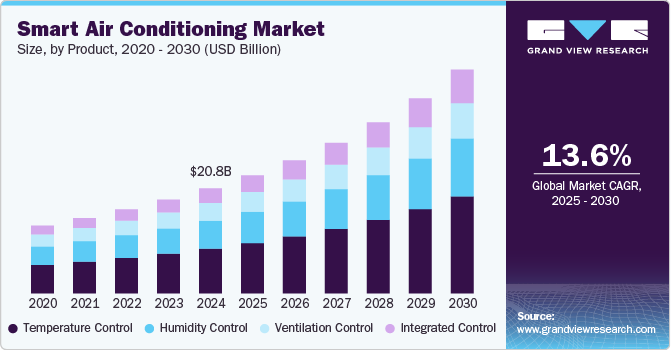
Smart Air Conditioning Market Size & Trends
The global smart air conditioning market size was estimated at USD 20.75 billion in 2024 and is expected to witness a CAGR of 13.6% from 2025 to 2030. The smart air conditioning industry is growing quickly as demand for energy-efficient and connected cooling solutions increases. Features such as remote control, automation, and integration with smart home systems are attracting residential, commercial, and industrial customers. The need for energy savings and improved air quality is boosting the market's growth further. Consumers are increasingly looking for sustainable and cost-effective ways to cool their spaces. As a result, smart air conditioning systems are becoming a popular choice for those seeking enhanced comfort and efficiency.
Request Free Sample Report: https://www.grandviewresearch.com/industry-analysis/smart-air-conditioning-market
Product Insights
The Temperature Control segment led the market and accounted for 42.5% of the global revenue in 2024. Temperature control has been the dominant feature in the smart air conditioning industry, as it directly affects user comfort and is the primary function of traditional air conditioning units. Consumers have long prioritized the ability to precisely control room temperatures to ensure a comfortable environment.
Application Insights
The Residential Buildings segment led the market. With the rise of smart home technology, there is an increasing demand for HVAC systems that seamlessly integrate with home automation platforms. Companies are emphasizing the importance of connectivity by offering systems that can be controlled remotely through mobile apps or voice assistants, enhancing both convenience and user experience.
Regional Insights
North America accounted to hold significant share in the market and accounted for a 35.9% share in 2024. The market in North America is growing rapidly due to increased consumer demand for energy-efficient and environmentally friendly solutions. The adoption of smart thermostats and HVAC systems integrated with IoT technology is becoming more common in both residential and commercial buildings.
Key Smart Air Conditioning Companies:
The following are the leading companies in the smart air conditioning market. These companies collectively hold the largest market share and dictate industry trends.
- DAIKIN INDUSTRIES Ltd.
- Electrolux Group
- Carrier
- Hitachi, Ltd.
- MITSUBISHI ELECTRIC CORPORATION
- Panasonic Holdings Corporation
- Voltas Ltd.
- Johnson Controls
- TOSHIBA CORPORATION
- FUJITSU GENERAL
Global Smart Air Conditioning Report Segmentation
This report forecasts revenue growth at global, regional, and country levels and provides an analysis of the latest industry trends and opportunities in each of the sub-segments from 2018 to 2030. For this study, Grand View Research has segmented the global smart air conditioning market in terms of product, application and region.
Product Outlook (Revenue, USD Billion; 2018 - 2030)
Temperature Control
Humidity Control
Ventilation Control
Integrated Control
Application Outlook (Revenue, USD Billion; 2018 - 2030)
Residential Buildings
Commercial Buildings
Industrial Buildings
Regional Outlook (Revenue, USD Billion; 2018 - 2030)
North America
U.S.
Canada
Mexico
Europe
UK
Germany
France
Asia Pacific
China
Japan
India
Australia
South Korea
Latin America
Brazil
Middle East & Africa (MEA)
KSA
UAE
South Africa
Browse Full TOC: https://www.grandviewresearch.com/industry-analysis/smart-air-conditioning-market

Comments
Post a Comment