Healthcare Analytics - Enabling Healthcare Providers To Identify Early Indicators Of Acute Or Chronic Ailments And Pursue A More Preventive Care Approach
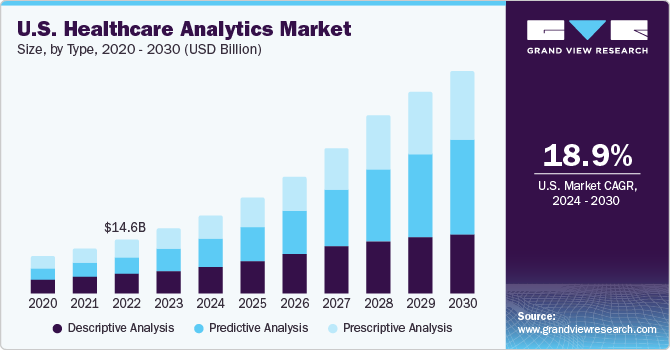
Healthcare analytics is witnessing exponential growth due to the high adoption of digitization in healthcare, increased healthcare IT expenditure & infrastructure, and the emergence of entrepreneurial ventures addressing several different niches of healthcare IT. Advancements in healthcare analytics such as the development of descriptive and predictive analytics used in managing clinical trials, regulatory compliance, organizing supply & demand chains, and pharmacovigilance. Implementation of advanced analytical solutions enables the healthcare fraternity to predict high-risk populations and strategize action plans accordingly. According to a study by JAMA Network in the U.S. on COVID-19 patients admitted to hospitals, data points on admission were collected, collated, and analyzed to understand the underlying risk factors more accurately & closely. Moreover, the CMS is developing next-generation predictive analytics, which will boost the usage of predictive analytics. The healthcare and medical industry are undergoing a paradigm shift due to the ushering in of the digital health era through the digitalization of health records, improving software solutions, advanced mobile applications, and widespread implementation of big data & cloud storage.
Research Insights:
Healthcare Analytics
The global healthcare analytics market is expected to expand
at 21.5% CAGR from 2022 to 2030. The global data generation grew by 5000%
between 2010 to 2020, and analytical solutions allow stakeholders to analyze
this data in multiple structured & unstructured forms and draw data-driven
actionable insights. Data analytics has enabled significant advancements in the
field of medical research. For instance, data scientists from Blue Cross Blue
Shield in collaboration with Fuzzy Logix analyzed and identified approximately
742 risk factors for a person abusing opioids. Similarly, the Cancer Moonshot
initiative implements advanced data analytical tools and solutions in their
research of innovative cancer cures. There has been an increase in awareness
among end users regarding the benefits of big data analytics such as focused
financial services, operational & administrative services, clinical
services, sales & marketing analysis in the life science industries,
pharmaceutical innovation & drug safety trials, and various safety analysis
for healthcare companies. The growing adoption of these technologies enables
data exploration and analysis.
The growing trend of hybrid platforms enables healthcare
organizations to integrate healthcare data with analytics capabilities & function
as analytics hubs for big data, and the growing adoption of advanced artificial
intelligence and machine learning algorithms will bolster the market growth.
For example, DevOps is used in curtailing increasing expenses in
pharmaceuticals and enhancing productivity & efficiency. Another trend
catching up pace in association with data science & analytics is the
digital twins, which are supporting organizations in modeling and simulation.
Routine procedures are broken into quantitative numerical information using
healthcare data analytics and these data blocks are used by organizations to
build digital replicas to experiment & optimize these procedures by
conducting simulations. Lastly, the growing demand for personalized treatment
solutions and preventive care approaches is driving the adoption of healthcare
analytics. Historic datasets of patient information are being integrated and
analyzed using data generated from at-home patient monitoring devices along
with predictive analytical tools, allowing healthcare providers to identify
early indicators of acute or chronic ailments and pursue a more preventive care
approach.
Free Request Sample: Healthcare Analytics PDF Sample

Comments
Post a Comment